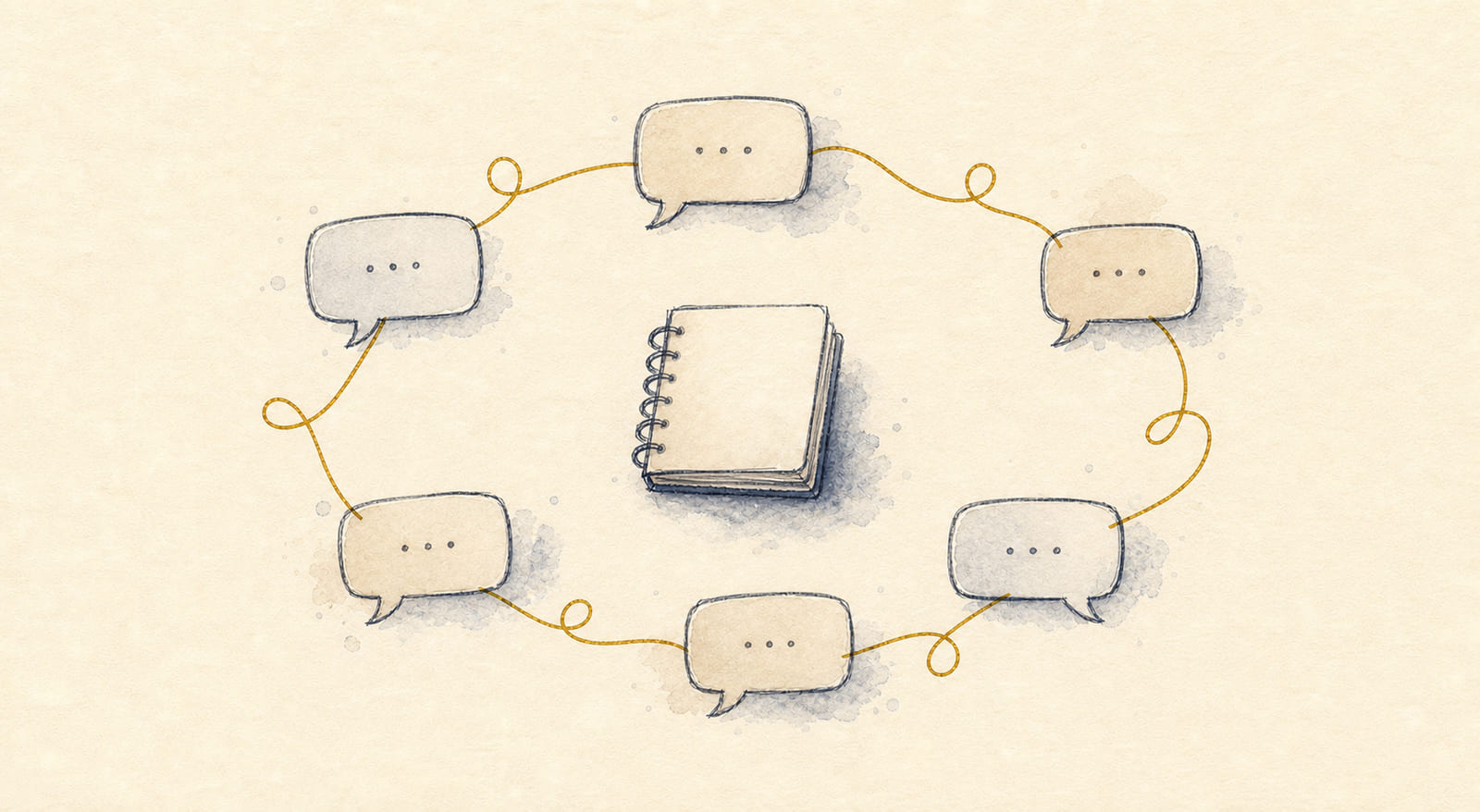
Conversations don’t end anymore
Modern communication has become ambient, semi-open, and psychologically strange. The real burden may be unresolved context rather than unfinished tasks.
Why this matters
I keep noticing how rarely conversations finish now.
They pause. They idle. They come back three days later with no warning. A WhatsApp thread carries a voice note, a heart reaction, a half-answer, a reminder, and then, somehow, the emotional weight of a thing nobody has quite closed.
Older communication had more obvious edges. You called someone, spoke for a while, and hung up. You wrote an email, sent it, and waited. Even text messages used to feel more like small episodes.
Now most communication feels ambient. It sits around the edges of the day like laundry you keep meaning to fold.
Microsoft’s 2025 Work Trend Index special report called this the “infinite workday”. Their research found a day beginning early with email, swelling into Teams messages and meetings, then stretching into late-night meetings and cross-time-zone work. The exact work stack differs by person, but the feeling is familiar: there is no clean start and no clean stop.
The problem is not just too many messages.
It is too many unresolved loops.
Worked example
A message arrives at 9am while you are making coffee. You read it, understand it, and decide to answer later because it deserves care. At lunch, another message lands on top of it. By evening, the original thread has sunk down the screen but not out of your head.
Nothing dramatic happened. Nobody was rude. No task manager would flag it as a major issue.
But part of your mind is still holding the thread open.
Microsoft’s report says the average worker receives 117 emails daily and 153 Teams messages per weekday. It also says meetings after 8pm were up 16% year over year, with 30% of meetings spanning multiple time zones. These are workplace numbers, but they point to something wider: modern life keeps producing open surfaces for response.
The phone is absurd when you really look at it.
Then come the secondary systems: delivery updates, health reminders, school messages, admin alerts, app notifications, payment prompts, and the strange category of software that pings you mainly to remind you it exists.
We try to solve this with organization. Notes apps. Task apps. Reminders. Notion. Handwritten lists. Sending ourselves WhatsApp messages because somehow that feels easier than opening the correct tool.
Eventually the organization layer becomes another queue.
Productivity culture often treats this as a capture problem:
- Capture the task.
- Prioritize the task.
- Complete the task.
- Archive the task.
That works for some things. It does not work for all the residue.
A difficult conversation with a friend is not simply a task. Neither is worrying about your child, thinking you forgot something important, or carrying a tense work exchange into dinner. A lot of the load is not action. It is context still looking for somewhere to land.
The exhaustion often comes from unresolved context rather than unfinished tasks.
This is why I am cautious about the next wave of AI assistants that promise to manage everything. More memory can help. Better summarization can help. Good routing can help.
But if every conversation, obligation, message, and reminder flows into one grand cognitive dashboard, we may not get coherence. We may get a faster version of the same crowd at the information desk, all asking for closure from a system that mostly knows how to sort the queue.
Limitations / not a fit
This is not a complaint that technology is bad. I like good tools. I want AI to reduce the needless admin of modern life. A good assistant that protects attention, remembers appropriately, and helps close the right loops could be genuinely useful.
The risk is flattening.
Not every open loop deserves the same treatment. A client follow-up, a message from a friend, a half-formed idea, and a family worry are not just items in a universal inbox. They have different emotional weights, different privacy needs, and different kinds of closure.
So the best AI products here may not be the ones that make people respond faster.
They may be the ones that help people recover judgment. What should be answered now? What can wait? What should be forgotten? What should never have become a notification in the first place?
I still think the deepest modern problem is not productivity.
It is unresolved context.
And any tool that claims to help should be judged by whether it gives people a little more coherence, not just another beautifully sorted pile.
Sources
- Microsoft WorkLab: Breaking down the infinite workday
- Microsoft: 2026 Work Trend Index Annual Report
- Cal Newport: Books and writing