The Open Finance Roadmap Is Really a Product Backlog
Open finance will not become real because a roadmap exists. It becomes real when rights are turned into product work people can actually use.
Why this matters
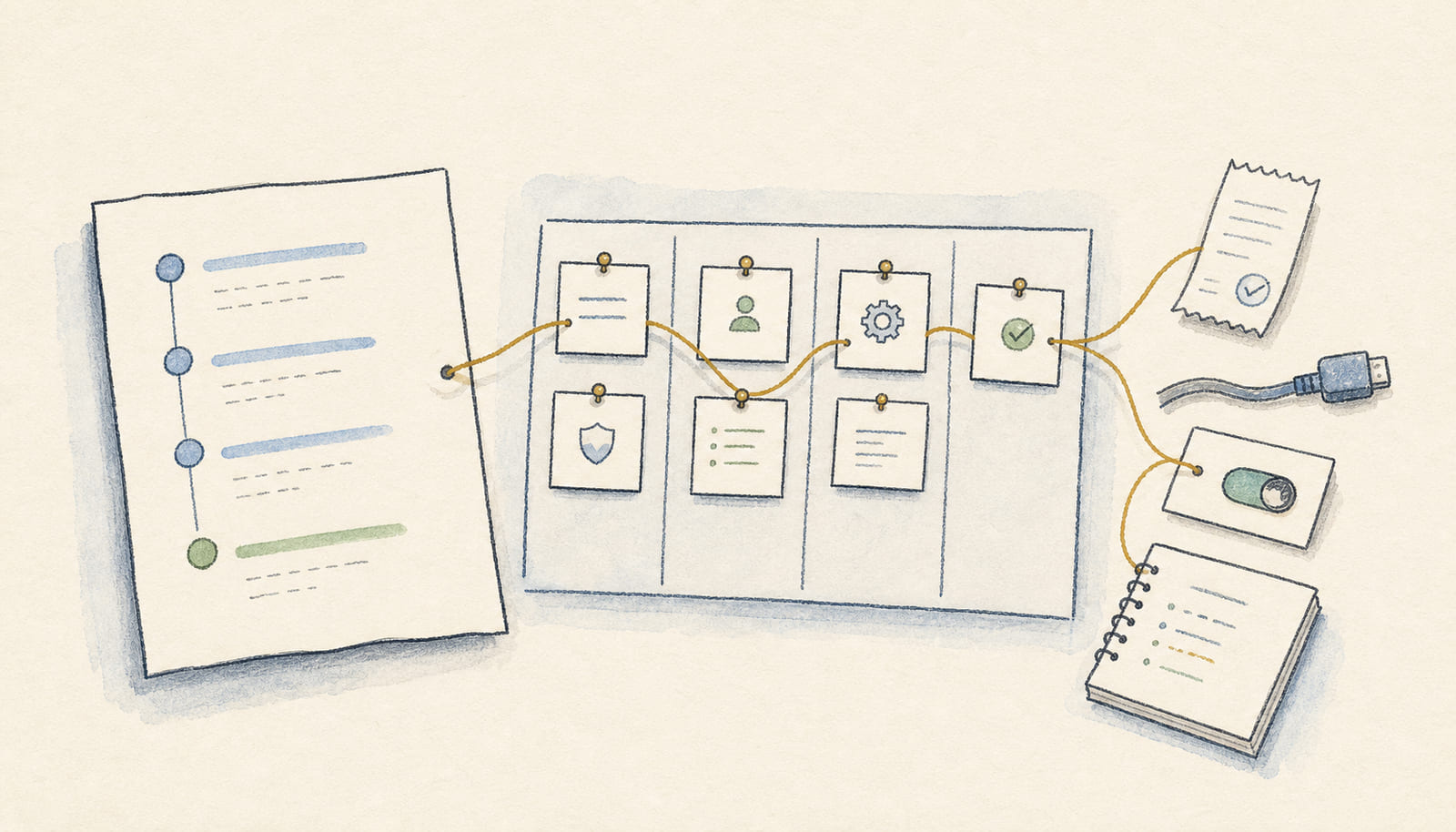
A policy roadmap can look like a PDF until you read it as a product backlog.
That is what makes the FCA’s 2026 open finance roadmap interesting. It is not just another statement that people should have more control over financial data. It sketches a sequence of work: identify high-impact use cases, run experiments, test delivery models, design the framework, then scale what works.
That is the right shape of the problem.
Open finance is often discussed as a rights story. People should be able to share their own financial data with the providers, advisers, lenders, and tools they choose. I agree with that. But rights do not become useful just because they exist on paper.
Someone has to turn them into something a person can safely use on a Tuesday afternoon, while applying for a mortgage, trying to get credit for a small business, consolidating old accounts, or asking an adviser for help.
That is product work.
Worked example
The FCA roadmap, published on 14 April 2026, sets out work through 2030. The early focus is deliberately practical: collaboration in 2026, framework design in 2027, and then scaling and delivery between 2028 and 2030. Alongside that, the FCA has been running open finance TechSprints around consumer mortgages and SME finance.
Those are not glamorous use cases. That is partly why they are useful.
Open finance is not going to prove itself first in a glossy dashboard that claims to understand your whole financial life. It is more likely to prove itself where missing data creates visible friction: a mortgage application that needs too many documents, a small business loan that cannot see enough context, an advice process that starts by asking the client to rebuild the same financial picture again.
The useful work is less abstract than the slogan.
| Rights language | Product work underneath |
|---|---|
| ”The customer controls their data” | Clear permission scopes, revocation, receipts, and plain-English reuse rules |
| ”Data can move between providers” | Identity checks, API reliability, error handling, and dispute routes |
| ”Consent enables better outcomes” | A visible reason to share, a visible return, and a clean way to stop |
| ”Open finance supports innovation” | Specific use cases that survive operational, commercial, and regulatory reality |
The danger is that the industry treats the right as the finish line.
It is not.
The right is closer to the planning permission. The building still has to stand up in bad weather.
Where this gets real
The hard part of data ownership is the hand-off.
Who is asking for the data? For what purpose? For how long? What happens if the connection breaks? Can the person see what was shared? Can they revoke it without losing access to everything? Who is responsible if the receiving product infers something wrong?
These are not edge cases. They are the operating model.
And they matter more in finance because the data is not casual. It includes income, debts, spending patterns, old pensions, investment history, family obligations, business cash flow, and the awkward parts of life that rarely fit neatly into a form.
So the best open finance products will not merely connect more accounts. They will make the exchange feel worth it.
They will answer the user’s quiet question:
That might mean a faster mortgage journey. A better SME credit assessment. An adviser who starts with context instead of paperwork. A personal finance tool that can remember enough to be useful without becoming a black box.
The product has to earn the data.
Limitations / not a fit
There is a risk in over-reading any roadmap. A roadmap is not adoption. It does not solve commercial incentives, liability, data quality, consumer understanding, or the slow work of standards.
It also does not guarantee that open finance will feel good to use.
A badly designed permission flow can still be technically compliant and emotionally useless. A customer can still click through without understanding what they have allowed. A receiving product can still collect more than it returns. A provider can still make revocation feel like pulling wires out of the wall.
That is why I like the backlog framing. It keeps the conversation honest.
Open finance is not one invention. It is a lot of small, dull, consequential product decisions stacked on top of each other: consent copy, permission scopes, source labels, logs, error states, complaints, revocation, portability, audit, and the moment where someone asks for help and the system either has enough context or it does not.
The future will probably not belong to the firm with the loudest open-finance story.
It will belong to the one that turns the right to share data into a useful, inspectable, reversible experience.
That is when open finance stops being a policy phrase and starts becoming part of someone’s financial life.
Sources
- FCA: Open finance roadmap
- FCA: Open Finance TechSprints - consumer mortgages and SME finance
- FCA: FCA sets out vision for open finance