The Next Wealth Product May Be a Personal Financial Data Vault
If open finance makes data more portable and AI advice becomes more context-hungry, the missing product may be a personal financial data vault.
Why this matters
The simple wish is this:
I want one safe place where my financial life makes sense to me before it makes money for anyone else.
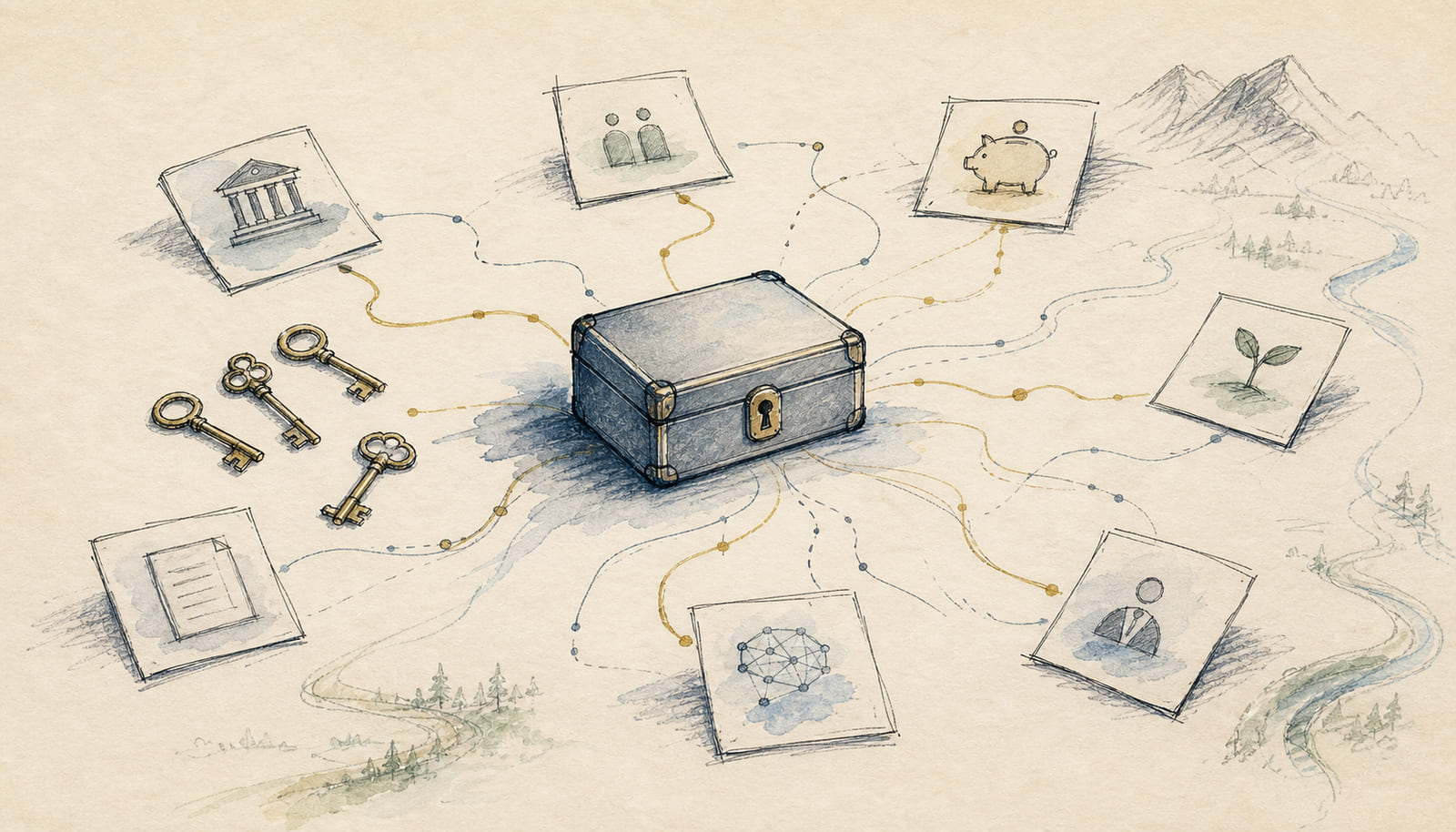
That is not how most financial data feels today. It is scattered across banks, cards, brokers, pensions, tax systems, insurance providers, mortgage documents, adviser notes, PDFs, apps, inboxes, and old logins that behave like locked cupboards.
Open finance is trying to make more of that data shareable. AI advice is making that data more valuable because better answers need better context. Wealth firms are thinking seriously about AI-ready data foundations.
Put those together and a missing product starts to appear.
Not another dashboard.
A personal financial data vault.
Worked example
A dashboard shows things. A vault controls things.
That distinction is important. A dashboard can tell you balances, trends, and maybe a few summaries. A vault would hold the permissioned context of your financial life and help you decide who gets to use which part of it.
It might connect to your bank, broker, pension provider, tax documents, mortgage data, insurance policies, adviser records, and personal AI. It would not simply gather everything into a prettier pile. It would manage context.
| A financial dashboard | A financial data vault |
|---|---|
| Shows what is connected | Controls what can be used |
| Focuses on visibility | Adds permissions, correction, and portability |
| Helps the person look | Helps the person act safely |
| Usually belongs to an app | Should belong to the person |
This idea is speculative, but it is not coming from nowhere.
Mastercard’s 2026 State of Open Finance report points to consumer willingness to share data when it improves financial journeys. The CFPB’s personal financial data rights work, despite its current legal and policy uncertainty, still reflects the pressure toward more practical consumer control over financial data. The FCA describes open finance as extending data-sharing principles beyond payments into areas such as credit, mortgages, savings, pensions, and insurance. BCG’s work on AI in wealth management argues that AI-first firms need better data foundations for agentic workflows.
All of that creates a strange gap.
Institutions are building better data layers. AI tools are asking for richer context. Regulators are pushing, unevenly, toward data access and sharing.
But the person still needs a home for the context.
The next wealth product may not be the app that shows the best chart. It may be the one that gives the person the best control surface.
A vault would need to answer ordinary questions in a serious way:
- Which data did I share?
- Who can see it?
- What can they do with it?
- What has changed since last time?
- Which parts are wrong?
- What should my AI assistant remember?
- What should stay private?
That is much closer to personal infrastructure than a normal finance app.
Limitations / not a fit
A financial data vault would not magically solve advice, security, regulation, or data quality. It could become another place where messy information collects dust. It could become overbuilt. It could become a new lock-in layer pretending to be user control.
So the bar would need to be high.
The vault would have to be boringly good at permissions, exports, revocation, audit trails, and corrections. It would have to separate viewing from acting. It would have to work with advisers rather than pretending everyone wants to become their own financial analyst.
Most importantly, it would need to be useful before it becomes grand.
Start with the map. Help the person find what they have. Help them clean the context. Help them share one slice of it for one purpose. Help them withdraw that access later.
That is enough of a product thesis for now.
Financial data is becoming more portable. AI is becoming more context-hungry. Wealth advice is becoming more data-dependent.
Someone still needs to build the place where the person remains in charge.
Sources
- Mastercard: The State of Open Finance 2026
- CFPB: Personal financial data rights
- FCA: Open banking and open finance
- BCG: AI and the Future Economics of Wealth Management