The Problem With AI Privacy Controls Is That Users Cannot See the Boundary
AI privacy settings are only useful if people can understand the boundary they are controlling.
Why this matters
There is a familiar kind of privacy settings screen.
It has toggles. It has policy language. It has links to learn more. It gives the user choices, technically speaking.
And yet, after looking at it, the person still does not really know what happens to the thing they type.
That is a problem for AI products because the inputs can be unusually personal. People ask for help with work, health, money, family, relationships, writing, fears, plans, and decisions they have not said out loud elsewhere.
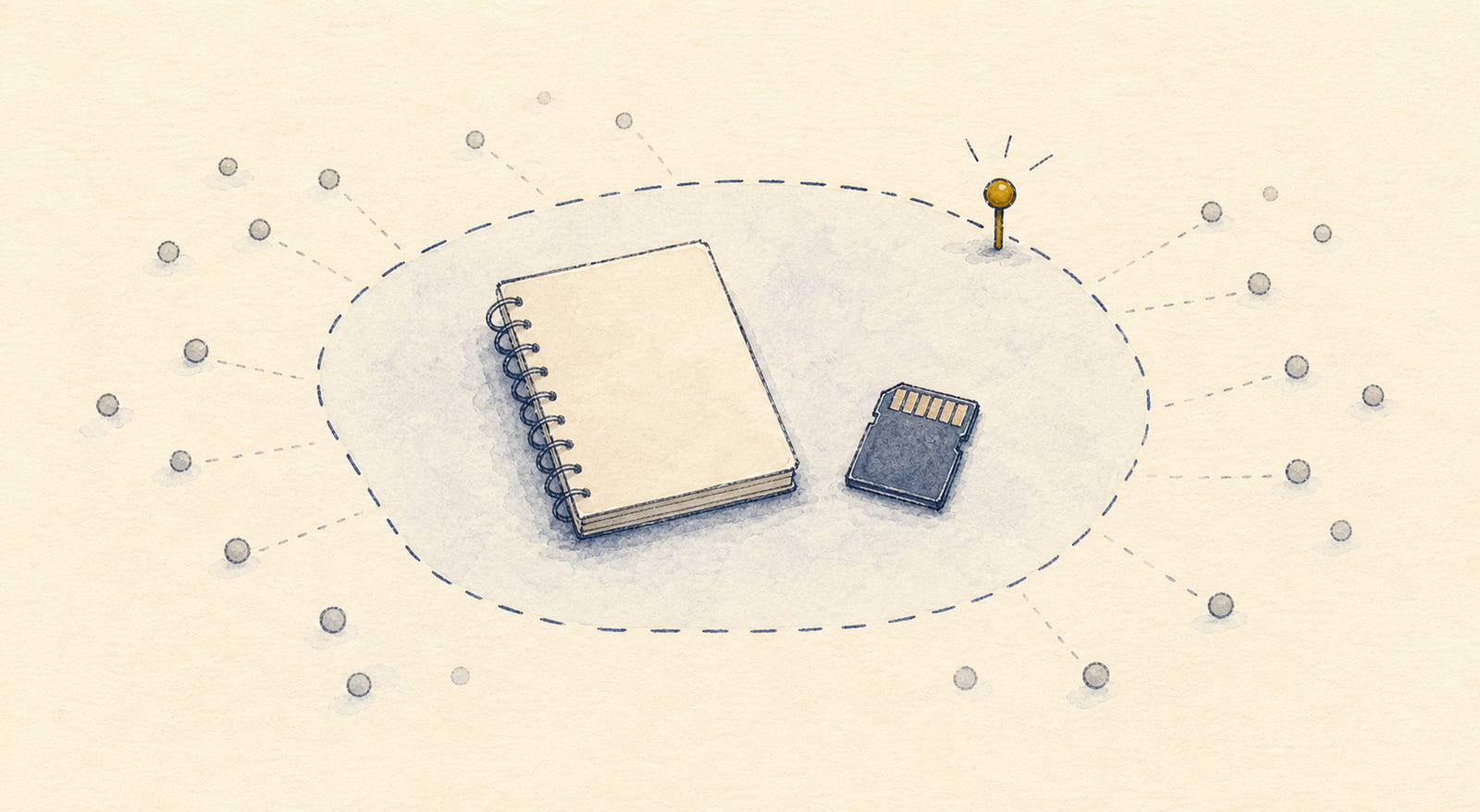
So a privacy control that merely exists is not enough. The user has to understand the boundary.
Worked example
A recent 2026 paper on consumer-facing generative AI looked at what security and privacy transparency users actually need. The researchers interviewed and ran design sessions with U.S. GenAI users, and found that available security and privacy information often felt incomplete, ineffective, or lacking credibility. People sometimes relied on rough proxies, such as popularity, to infer whether a tool was safe enough.
That rings true.
Most people are not trying to become privacy engineers before asking a tool for help. They are trying to answer a practical question:
That question breaks into a few smaller ones:
- Is this remembered?
- Is it used for training?
- Is it searched later?
- Is it retained in logs or files?
- Can I delete it?
- Can I see what the system thinks it knows?
Those are not edge-case details. They are the boundary of the relationship.
When a product hides that boundary behind vague controls, it asks the user to guess. And guessing is a weak foundation for trust.
OpenAI’s Memory FAQ now gives a useful concrete example of where this interface may be heading. Its Memory Sources feature can show source categories that informed personalization, such as past chats, saved memories, custom instructions, files, or a connected app in eligible regions and plans.
That is not perfect transparency. OpenAI is careful that source visibility may not explain every factor behind a response. But it is still an important product clue: a useful privacy control does not only say “memory is on”. It shows the person what kind of personal context has entered the room.
Limitations / not a fit
This does not mean every AI product should expose every internal detail.
Nobody wants a settings screen that reads like an infrastructure diagram. Most users do not need to know every queue, cache, model endpoint, and retention pipeline.
But they do need a plain-English boundary around the parts that affect trust.
That boundary might say: this conversation is remembered, this one is temporary, this file can be reused later, this data is not used to train models, this memory can be corrected, this output can be deleted, this request may leave the device.
That is product work, not just legal work.
The best AI privacy controls will probably feel less like policy pages and more like good labels on a workshop shelf. You do not need to understand every tool in the room. You do need to know what is sharp, what is shared, and what should be kept away from everyone else.
Sources
- IAPP: New study maps the privacy gap in consumer AI
- arXiv: What Security and Privacy Transparency Users Need from Consumer-Facing Generative AI
- OpenAI Help Center: Memory FAQ