The Unofficial Family CIO
The family CIO is not the person who knows the most about technology. It is the person who knows how technology fits this particular family.
The request never sounds like a job
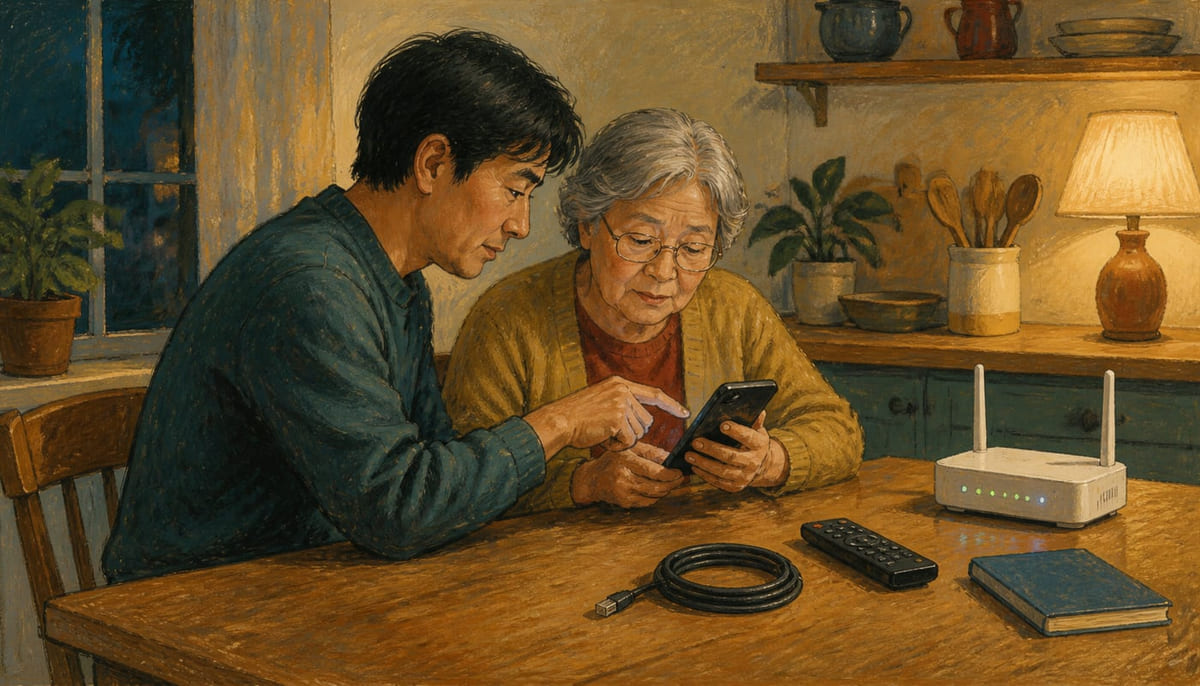
The family technology problem rarely arrives as a ticket. It arrives as a phone held out across the kitchen table.
Can you look at this?
The Wi-Fi has stopped working. A photo library is full. A subscription is charging the wrong card. The school login has expired. Somebody bought a new phone and now the banking app does not recognise them. The printer, after several peaceful months, has remembered that it is a printer.
Most families eventually appoint somebody to sort these things out. There is no discussion and certainly no job description. The role goes to whoever fixed the first few problems without making matters worse.
That person becomes the unofficial family CIO.
Nobody needs to be the expert
Researchers have a better and warmer name for this person: the warm expert. The term describes a relative or friend who has enough digital experience to help and enough knowledge of the person to make the help fit.
The expertise is relative. You do not need to understand network engineering to know that your father’s television loses its connection after a power cut, or that your aunt will abandon an app if an update moves the one button she uses.
That closeness is the useful part. A help desk knows the product. The family CIO knows the product, the person and the history of every failed attempt to make the two get along.
It is why this work quickly expands beyond fixing devices. The same person starts to remember which email address owns the streaming account, whose number receives the recovery code, why one old cable must never be thrown away and which apparently duplicate charge is actually intentional.
They are not merely solving faults. They are carrying context.
The work is larger than the visible problem
A 2026 CHI paper on hidden work in the home surveyed 50 people about the cognitive labour involved in running a household. The researchers found that much of this work is difficult to see, share or value. Family management is collaborative, yet many of the tools used to support it are still designed for one person.
That describes household technology surprisingly well.
The family shares the internet connection, subscriptions, devices, photographs and increasingly the practical consequences of digital public services. But the knowledge that keeps those things usable often sits in one person’s head, one password manager or one long-running message thread.
That knowledge can look trivial from the outside. It is made of exceptions, workarounds and memories. It is also what makes the difference between a device that technically works and one that somebody can actually use.
One person quietly becomes the system
Consider a fairly ordinary internet failure. The router light has changed colour. Restarting it does nothing. The provider asks for an account number.
In some homes, one person knows that the contract is still in a former address, the account is under somebody else’s email and the provider will only speak to the named customer. They also know which cupboard contains the original letter and that the backup connection is a phone hotspot whose password changed last Christmas.
None of this is advanced technical knowledge. Together, it is the household’s operating memory.
When the person carrying it is travelling, ill, busy or simply tired of being called, the fragility becomes obvious. The house owns all the relevant devices and accounts. It just cannot operate them without its human index.
The answer is not to turn family life into an IT department. A household does not need a service desk, a governance committee or an incident severity scale for the dishwasher.
It may need one small continuity note.
A one-page backup is enough
The useful version is not a shared document full of passwords. It is a short map of the things another person would struggle to reconstruct under pressure:
- which email address or family member owns each essential service;
- where recovery instructions and provider details are kept;
- which phone numbers receive important verification codes;
- what is strange about the router, printer, television or alarm; and
- who else can take over when the usual person is unavailable.
The note should point towards secure information, not duplicate it. It can say that emergency access is held in a password manager without copying the credentials into a document called Family passwords.
Review it occasionally, perhaps when a phone or broadband contract changes. The purpose is not perfect documentation. It is to stop one person’s memory becoming an irreplaceable component of the home.
Care is not the same as access
The role also has an uncomfortable edge. Helping can slide into taking over.
An older relative may want assistance with a phone without wanting a younger family member inside their messages, health records or bank account. Somebody who can recover every account can also become a gatekeeper, even with good intentions. A useful family CIO explains, asks and leaves the other person with as much control as possible.
A 2025 analysis of warm experts makes a broader warning too. Informal support is unevenly distributed, time-consuming and sometimes emotionally difficult. Not everybody has a capable relative nearby, and families should not be treated as the answer to inaccessible digital services.
Good formal support still matters. So do accessible products, patient staff and recovery processes that do not assume every customer has somebody younger standing beside them.
But inside many homes, somebody is already doing this work. They reset, explain, remember, reassure and occasionally find the right cable in a drawer of twenty wrong ones.
The least we can do is notice that this is care, thank the person providing it and make sure they have a backup.
Sources
- Sarah Lucy Frampton, Sandy J.J. Gould and Anna L. Cox: The Domestic Operating System, presented at the 2026 CHI Conference on Human Factors in Computing Systems, 13–17 April 2026.
- Riitta Hänninen and Sakari Taipale: Warm experts among us, first published online 29 October 2025.